
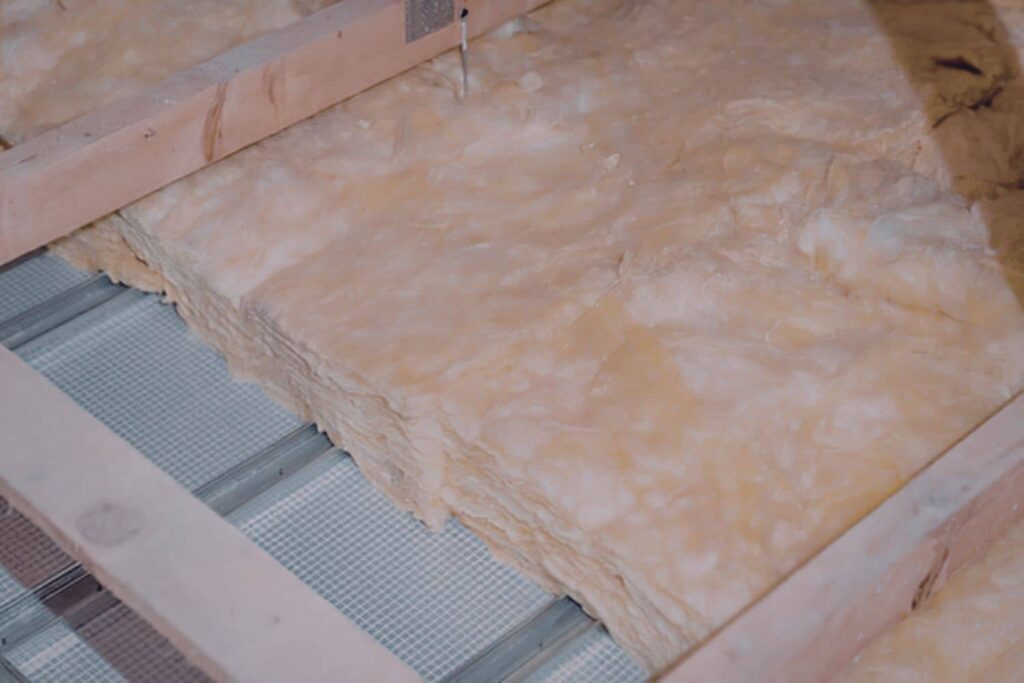
If you have ever poked around in an attic or pulled back a wall panel during a renovation, you have probably noticed that insulation does not all look the same. Some of it has a paper or foil layer on one side. Some of it does not. That difference is not just cosmetic. It tells you something important about where the insulation belongs, how moisture moves through your home, and whether what is already in place sits correctly.
Faced versus unfaced insulation is one of those topics that sounds technical but comes down to a few straightforward ideas. Understanding the difference helps you make better decisions on a new build, a remodel, or when something comes up on a home inspection report.
What Is Faced Insulation?
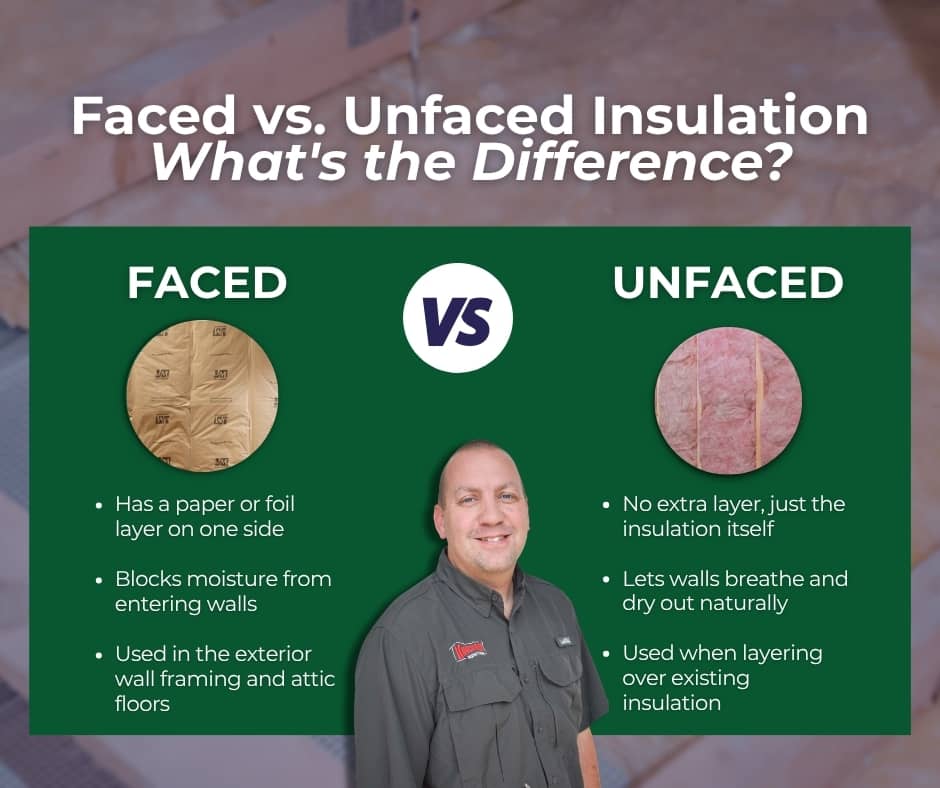
Faced insulation has a vapor retarder on one side, usually kraft paper or foil. That layer slows the movement of moisture through the insulation and into building cavities. The facing acts as a barrier between the warm, humid side of a wall or ceiling and the cooler structural framing behind it.
This matters because moisture that gets into wall cavities and attic framing can lead to mold, wood rot, and long-term structural damage. In humid climates like Alabama, Mississippi, Louisiana, and the Florida Panhandle, controlling moisture movement is not a minor concern. It is one of the central challenges of building and maintaining a home.
Manufacturers sell faced insulation most commonly in batts or rolls, sized to fit between standard wall studs, floor joists, and attic rafters.
What Is Unfaced Insulation?
Unfaced insulation has no vapor retarder. It is just the insulating material itself, whether that is fiberglass, mineral wool, or another product. Without a facing layer, it does not restrict moisture movement in either direction.
That might sound like a drawback, but it is actually the right choice in a number of situations. When another material in the assembly already handles moisture control, or when two-way drying outperforms one-way blocking, unfaced insulation works better.
It is also the standard choice when adding insulation on top of existing insulation in an attic. A second vapor retarder traps moisture rather than protecting against it.
Where Each Type Belongs
The right choice depends on where in the home the insulation goes and the climate where the home sits.
| Location | Recommended Type | Why |
| Exterior walls (new construction) | Faced | Vapor retarder faces the warm side |
| Attic floor (first layer) | Faced | Retarder faces down toward the living space |
| Attic floor (added over existing) | Unfaced | Prevents double vapor barrier |
| Basement walls | Unfaced (in most cases) | Allows the wall assembly to dry |
| Interior partition walls | Unfaced | No vapor control needed |
| Crawl space (between floor joists) | Faced | The retarder faces up toward the living space |
The general rule for faced insulation is that the vapor retarder faces the warm side of the assembly. In cold climates, that means the interior of the home. In mixed or hot-humid climates, which describe much of the Gulf Coast and Southeast, the guidance gets more nuanced. Building codes vary by state and zone.
Climate Zone Matters More Than People Realize
Homeowners in Alabama, Mississippi, and Louisiana live in climate zones that experts classify as hot-humid or mixed-humid. Florida’s Panhandle falls into a similar category. In these zones, moisture does not just push inward from cold outdoor air. It can move in either direction depending on the season, outdoor humidity, and whether the home has air conditioning.
This is why a blanket rule like “always put the facing toward the interior” does not always hold in the South. In some assemblies in hot-humid zones, a vapor-permeable or unfaced approach actually outperforms a vapor barrier because it lets the wall or attic assembly dry out when moisture does get in.
Building codes in each state address this, and what works in Maine will not necessarily match what is correct in Mobile. This is also why insulation that looks fine visually may still come up during a home inspection. An inspector may flag it if it creates moisture risk for that specific climate.
What Home Inspectors Look For
Insulation comes up regularly during home inspections. When inspectors assess attic and wall assemblies, faced versus unfaced is one of the things they evaluate. Common issues include:
- Faced insulation installed backwards, with the vapor retarder facing away from the warm side, directing moisture into the framing rather than away from it
- Double vapor barriers, where someone added faced insulation over existing faced insulation in an attic, trapping moisture between the two layers
- Missing insulation in key areas, including around attic hatches, knee walls, cantilevered floors, and rim joists
- Compressed or damaged insulation, which drops the effective R-value regardless of the facing type
- Kraft paper facing left exposed in finished spaces, which creates a fire code concern since paper-faced insulation needs a thermal barrier like drywall when it sits inside a finished room
These issues do not always rise to urgent safety concerns, but they can hurt energy performance, moisture control, and, in some cases, insurability, particularly for homes pursuing a FORTIFIED designation where building envelope integrity matters.
Insulation and FORTIFIED Homes
For homeowners and builders pursuing a FORTIFIED evaluation, insulation does not factor directly into the wind resistance criteria. However, the broader building envelope, including how a home manages moisture in wall and roof assemblies, connects to long-term durability and performance.
FORTIFIED standards design homes to resist the conditions that create structural damage. Correct insulation installation supports that goal by reducing the moisture-driven deterioration that weakens roof sheathing, wall framing, and floor systems over time. A home that holds up well against high winds stays better protected when the surrounding structure is also in good shape.
R-Value Is Separate From Facing
The facing of insulation does not change its R-value. R-value measures thermal resistance, and the insulating material itself determines it, not whether a vapor retarder is attached.
Faced and unfaced versions of the same fiberglass batt carry the same R-value. The facing adds moisture control. It does not add insulation performance. When comparing products, look at the R-value per inch and the total R-value for the installed thickness, not whether the product has a facing.
Other Questions to Explore
Does insulation affect how a home performs during a home inspection?
Yes. Inspectors evaluate insulation as part of the overall building envelope assessment. Incorrectly installed or damaged insulation can point to larger moisture or energy concerns that show up elsewhere in the report, including in the attic, crawl space, or wall assemblies.
What is a blower door test, and how does it relate to insulation?
A blower door test measures how airtight a home is by detecting where conditioned air escapes. Insulation controls heat transfer, but it does not seal air gaps on its own. A home can have adequate insulation and still lose significant energy through unsealed penetrations, which a blower door and air duct test will identify.
How does insulation factor into FORTIFIED home standards?
FORTIFIED evaluations focus on wind resistance and structural integrity rather than energy performance directly. However, a well-sealed and correctly insulated building envelope supports the long-term durability that FORTIFIED construction maintains, particularly in the hot-humid climate zones that cover most of Knockout’s service area.
Does a pre-listing inspection catch insulation issues before a buyer does?
It can, and that is part of its value. A seller who learns ahead of time that insulation is missing, compressed, or incorrectly installed has the option to address it before it becomes a negotiating point or a reason for a buyer to walk.
When to Call Knockout Inspections
If you are unsure whether the insulation in your home suits your climate zone, sits correctly, or performs as it should, a home inspection gives you a straightforward answer. This is especially worth doing when:
- You are buying a home and want to understand the condition of the building envelope
- You are planning a renovation that involves opening walls or adding insulation
- You have noticed moisture issues in an attic, crawl space, or basement
- Your home has older insulation that no one has ever evaluated
- You are working toward a FORTIFIED designation and want to understand how your home’s current condition fits into the process
Conclusion
Faced versus unfaced insulation is a small distinction that carries real consequences when people overlook it. The right type, installed correctly and oriented the right way, helps manage moisture, supports energy performance, and protects the structural integrity of the home over time. The wrong type, or a correct type that someone installed incorrectly, can do the opposite.
If you have questions about what your inspection report flagged about insulation, or want to schedule a thorough evaluation of your home’s building envelope, get in touch with the Knockout Inspections team today.